
Several of our yuletide traditions have some pretty interesting backstories. For instance, a well-known Bible scholar may have committed plagiarism when it comes to a famous holiday poem and the most famous illustration of good ol’ Saint Nick was actually political propaganda! Read on to learn more.
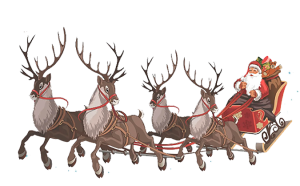 Though Clement C. Moore, a Bible scholar in New York City, has been credited since 1837, with writing the poem “A Visit from St. Nicholas” (aka “The Night Before Christmas”) evidence suggests that American poet Henry Livingston Jr. (1748 – 1828) originally wrote the piece. The now famous Christmas poem first appeared in the Troy Sentinel on December 23, 1823, after a friend of Moore’s sent it to the paper, believing Moore to be the author. In 1857, when the Livingston family learned Moore had been named as the author, Livingston’s children said they remembered their father reading the very same poem to them long before the poem had ever been published.
Newspaper artist and political cartoonist Thomas Nast gave us the donkey for the Democrats and the elephant for Republicans and, in 1881, the modern image of Santa Claus.
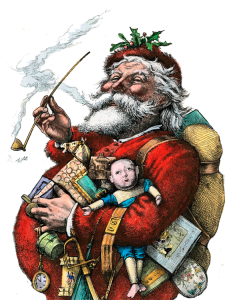 To the casual observer, it looks like an ordinary Santa. But that isn’t a sack full of toys on his back—it’s actually an army backpack. Nast biographers say the illustrator was always pro-military, and in 1881, when the military was due for a raise, Nast wanted to show his support. That’s why Santa is holding a dress sword to represent the Army and a toy horse, which was a reference to the Trojan horse and symbolized the treachery of the government. Santa’s pocket watch read ten ’til midnight, indicating the U. S. Senate was running out of time to give fair wages to the men of the Army and Navy.
File this under: Why does it take me YEARS to complete a manuscript when the likes of Dr. Seuss and Charles Dickens wrote classics in the matter of a few weeks?
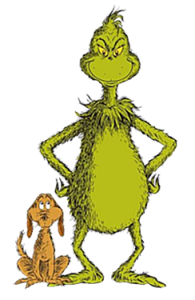 “I was brushing my teeth on the morning of the 26th of last December when I noticed a very Grinch-ish countenance in the mirror,” Seuss said in 1957. “It was Seuss! So I wrote about my sour friend, the Grinch, to see if I could rediscover something about Christmas that obviously I’d lost.”
Seuss wrote the book quickly and was finished with it within a few weeks, saying it was the easiest book he’d ever written, except for its conclusion. “I got hung up getting the Grinch out of the mess,” Seuss said. “I got into a situation where I sounded like a second-rate preacher or some biblical truism… Finally in desperation… without making any statement whatever, I showed the Grinch and the Whos together at the table, and made a pun of the Grinch carving the ‘roast beast’. … I had gone through thousands of religious choices, and then after three months it came out like that.”
Seuss’s step-daughter, Lark Dimond-Cates, stated in 2003, “I always thought the Cat… was Ted on his good days, and the Grinch was Ted on his bad days.” Further proof to back up this claim: Seuss drove a car with a license plate that read “GRINCH”.
Chuck Jones and Ben Washam adapted the story as an animated television special in 1966, featuring narration by Boris Karloff, who also provided the Grinch’s voice. However, the song, “You’re A Mean One, Mr. Grinch” was sung by Thurl Ravenscroft (who was also the voice of Frosted Flakes’ “Tony the Tiger”).
Charles Dickens, experiencing acute financial distress, wrote A Christmas Carol in six weeks—Ebenezer Scrooge and the Cratchit family emerged from the fog of his imagination as he walked the streets of London at night. Before you scoff, it’s important to note that, unlike 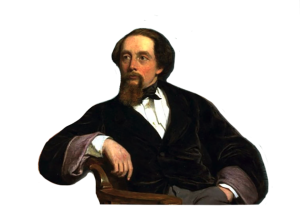 David Copperfield, which weighs in at around 358,000 words, A Christmas Carol, was meant to be read in a single sitting, and clocks in at a mere 27,000 – 29,000 words. So, six weeks—5,000 words a week—is not so far-fetched.
First published on December 19, 1843, A Christmas Carol had sold out by Christmas Eve. Despite this runaway success, Dickens preferred more expensive endpapers and bindery, which ate up a big chunk of his profits.
Dickens, still in financial straits, took A Christmas Carol to the stage and was credited with reinventing Christmas. (He is also said to have invented book tours.)
Today, people like to believe scenes in A Christmas Carol reflected how the holiday was celebrated in the 1840s. This, however, is not the case. Dickens was actually suggesting that Christmas, rather than a raucous, drunken festivity, be recast as a family-centered holiday. The book reinvigorated older traditions that had been lost like singing carols, enjoying a huge Christmas dinner with special holiday desserts. It also popularized newer traditions such as decorating Christmas trees and sending Christmas cards.
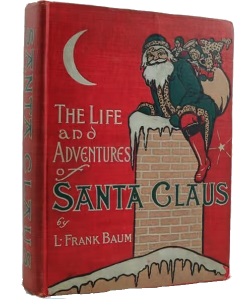 While everyone flocks to the cinema to see the latest installment of the Wizard of Oz, keep in mind L. Frank Baum wrote a lot more than stories about flying monkeys and questionable wizards. In addition to his 14 Oz books, Baum penned at least 42 scripts, 83 short stories, over 200 poems, and 41 other novels—including The Life and Adventures of Santa Claus, published in 1902.
After years of unsuccessfully trying to realize his works on the stage, he died in 1919, 20 years before the Wizard of Oz changed the movies forever. Nominated for five Academy Awards, The Wizard of Oz won two Oscars out of six nominations, losing to Gone with the Wind for Best Picture.
Interestingly, George Cukor was one of the original directors of the Wizard of Oz, influencing many of the costume and makeup decisions before leaving to direct Gone with the Wind. Cukor had also directed the highly successful 1933 film adaptation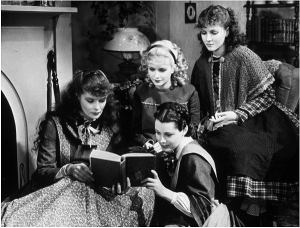 of Louisa May Alcott’s Little Women, starring Katharine Hepburn as Josephine “Jo” March. His was the third film of the novel, the first screening in the silent era in 1917 and 1918.
The novel opens with the four sisters lamenting their poverty and inability to celebrate Christmas properly. As they discuss gifts they’d like to have and what each could purchase with her small allowance, they hit upon a plan to pool their resources to buy gifts for their mother