
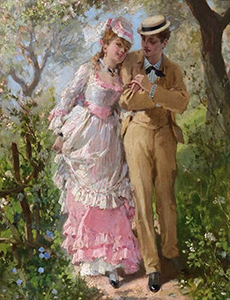
At the ripe old age of 38, Jane Austen (1775 – 1817) wrote: “We are all fools in love.”
She wasn’t wrong. Who among us hasn’t thrown caution to the wind, ignored all common sense, and fallen in love? And, as Alfred Lord Tennyson (1809–1892) observed, what better time to dive head-deep into love’s sweet arms than spring? When he was 44, no longer a young man himself, he wrote: “In the Spring a young man’s fancy lightly turns to thoughts of love.”
Currently, in the midst of spring here in the Lowcountry, or what some call the “Great Pollination,” Ice Folly Daffodils—whose very name signifies a lack of good sense and a propensity for fanciful ideas—have bloomed, announcing the change of the seasons with theirbright yellow trumpets. Huzzah! Winter has left the building!

Do you recall the song from Camelot, when Queen Guinevere sings about spring? (Yes, technically she’s singing about the month of May, but humor me because we’re at least a month ahead of England’s medieval calendar down here.)
It’s here, that shocking time of year
When tons of wicked little thoughts merrily appear…
It’s time to do a wretched thing or two
and try to make each precious day, one you’ll always rue!
(Somehow, I have difficulty imagining Julie Andrews performing these lyrics on Broadway as convincingly as Vanessa Redgrave did in the movie adaptation. [You can it watch here: https://www.youtube.com/watch?v=4L-4QuVHHRw ] But I digress.)
Humans aren’t the only ones who fall prey to base desires when warm weather arrives. To quote Thumper (Bambi’s pal in Disney’s 1942 animated classic), even critters become “twitterpated” this time of year.
Speaking of bunnies, Easter is just around the corner—specifically the first Sunday after the first full moon after the spring equinox. Who chose that addlepated logic to determine when we celebrate this holiday, you ask? Thank Roman Emperor Constantine, aka Constantine the Great, who, according to most accounts, was nobody’s fool. Among his many accomplishments were restructuring the government to create separate civil and military authorities; and fighting inflation by introducing a new gold coin, the “solidus,” which became the standard European currency for more than a thousand years.
Of course, Easter is not the only holiday this April. In honor of our latest release, Bohmemian(s) Today, set in Paris at the fin de siecle, and the height of the art nouveau movement, let us wish you:
Joyeux poisson d’avril
(Happy April Fool’s Day)
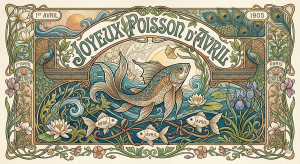
No foolin’! It’s a great day to fall in love—with a another human or a new book.
Throw caution to the wind and click here to learn more about Bohemian(s) Today
and other WayWord titles.