
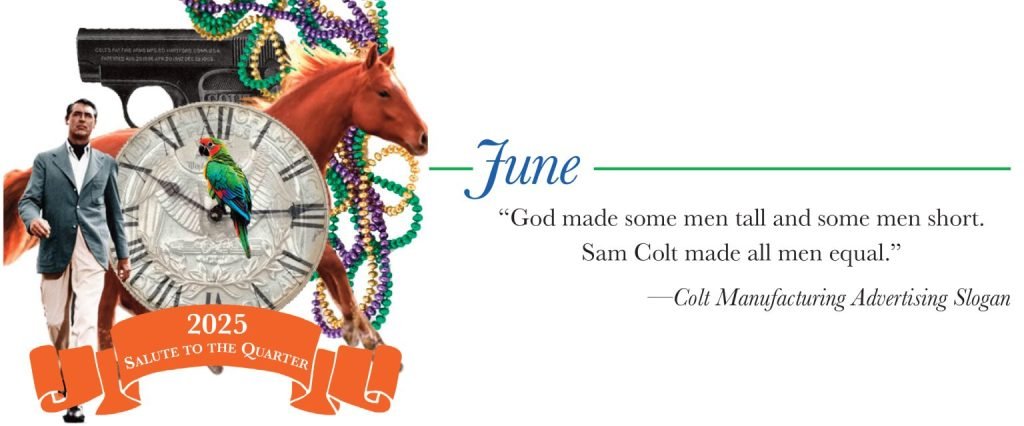
This month’s salute to the quarter may come as a surprise—we’re paying tribute to Bonnie Parker’s pistol of choice, the Colt .25.
It may be that guns are on our minds because our next release, Murder in Milan, includes a gun-wielding heroine by the name of Vanne Smith. In Vanne’s case, it’s a Bersa Thunder .380 with an ambidextrous magazine catch, which like Bonnie’s Colt .25, is small, compact, and efficient.
In its day, the .25 caliber Colt was branded ideal for men and women alike. Measuring only 4 1/2 ” long, it was easily concealed in purses or vest pockets. It featured speed, accuracy, and the hard-hitting qualities that “give confidence in an emergency.”
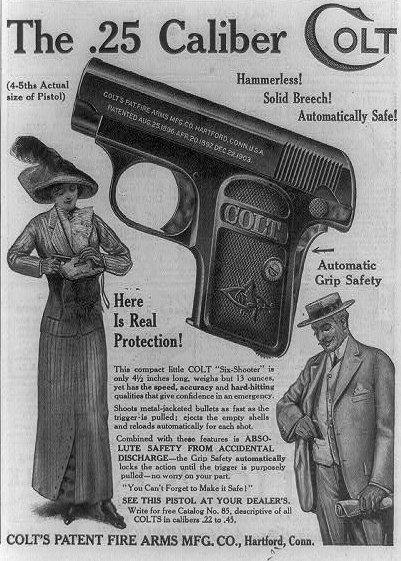
Its inventor, Samuel Colt, finally hit the bullseye when it came to manufacturing guns. After several failed business attempts, and aiming to blast the heck out of his competition, he loaded up on marketing gambits. Consider these bullet points:
- He placed multiple advertisements in the same newspapers—sometimes as many as eight in the same edition.
- Credited with the earliest use of product placement advertising, he commissioned a famous frontier artist to paint scenes of native Americans, wild animals, and bandits—all of which featured the victor heroically brandishing a Colt weapon.
- He hired authors to write stories about his guns for magazines and travel guides, and once paid United States Magazine $1,120 (equivalent to $41,384 today!) for a 29-page, illustrated story that showcased his factory.
- He directed agents to scour U.S. publications for news stories mentioning his guns, which he then excerpted, reprinted, and used as ammunition to prove his weapons’ superiority. He was known to give free revolvers to the editors who published those stories, especially if they disparaged his competition.
Though Colt died young (due to complications of gout in 1862 at age 47), his legacy endured and the popularity of personal weapons prevails to this day.
We’re giving you an extra bang for your buck in this blog, so please read on for a literary tie-in from Anton Chekhov.
“One must never place a loaded pistol on the stage if it isn’t going to go off.
It’s wrong to make promises you aren’t going to keep.”
—Anton Chekhov
Chekhov, of course, wasn’t only talking about guns. His point is that every element in a story must be relevant. Chekhov hated clutter.
Dr. Chekhov—he was a physician by profession—initially viewed writing as a way to earn extra income as he treated patients for free. Though his writing became quite popular, his plays presented a challenge to actors as well as audiences. In place of conventional action, Chekhov offered a “theatre of mood” with a “submerged life in the text,” introducing modern theatre, which showed a more realistic view of being human. To his critics, he said the role of an artist was to ask questions, not to answer them. He was also rather dashing, don’t you think?
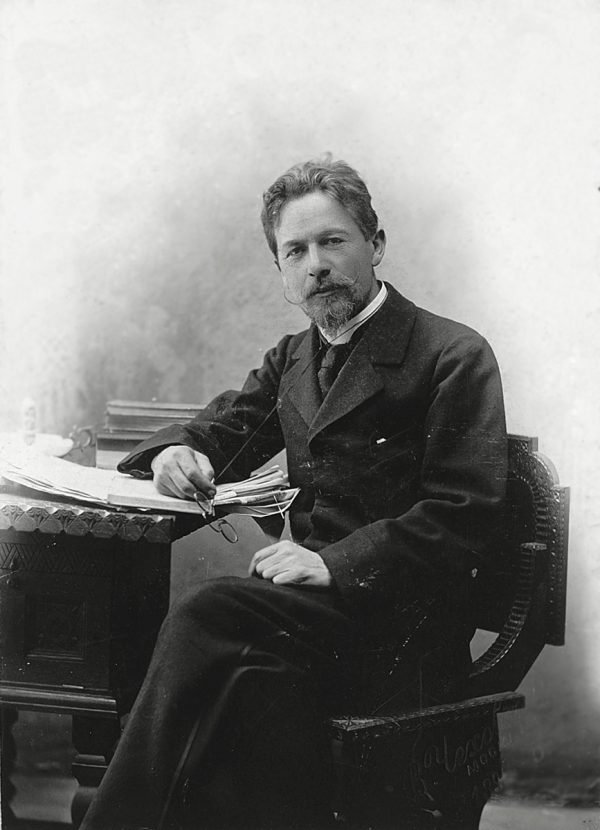
Sadly, he, like Sam Colt, died far too young. And also like Colt, his legacy lives on, sometimes to great hilarity.
In the animated comedy, Archer, the principle character, Sterling Archer, presents a pathetically passive Cyril Figgis with a “Chekhov Gun” while training him to be a ISIS field agent. The 25 caliber automatic pistol is also referred to as an “underwear gun,” due to Sterling’s preferred hiding place for it.
Does Murder in Milan follow Chekhov’s dictum? You’ll see this summer! Subscribe here
For another funny take on Chekhov and guns! Click here