
As the year gallops to a close, we pay our penultimate tribute to the quarter: this month, Susan looks at the Quarter Horse.
Hi Ho Silver!
On my way to class freshman year of college, I had a choice: lecture hall or stable.
I was not alone in my obsession; America’s love affair with horses can be traced back to Spanish conquistadors and their Barb horses–so named because they hailed from Africa’s Barbary Coast. In their quest for gold, Spaniards, like Francisco Vasquez de Coronado, arrived in the New World and headed west, across wide rivers, rolling plains, and into the mountains of what is today Arizona. Over time, their Barbs bred with English thoroughbreds, becoming American Quarter Horses.
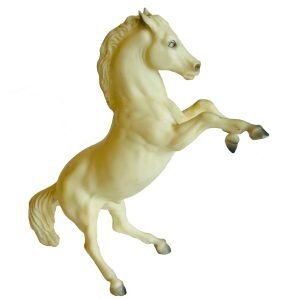
Growing up, I played with Breyer horses. I had a white stallion rearing up on his back legs ready to charge, a grey spotted palomino, and a chestnut mare. I’d watch any movie that featured horses and dreamed of riding a real horse myself. When I turned sixteen, my friends and I drove to a stable and rented horses. Even though I had never ridden a horse before, it came naturally to me. Soon, I became a regular at the stables, and my favorite was a Quarter Horse named Rachel.
I continued to ride through my college years, it was my therapy, my escape from all the drama that seemed so important at the time. Riding and controlling such a huge animal was both liberating and exhilarating.
Quarter Horses, amiable and strong, played a pivotal role in our nation’s history. Farm families relied on them to plow fields and carry goods to market. They were the primary mode of transportation across the land. They were fast, too, racing short distances–some reaching up to forty miles an hour when running a quarter mile, which is how they got their name.
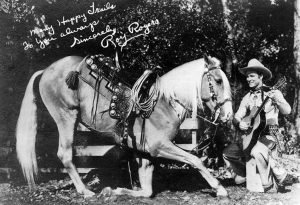
As the U.S. shifted from agriculture to industry, horses, too, shifted gears. Their dispositions made them ideal show biz stars–from Brigham, Buffalo Bill Cody’s favorite horse, and Black Nell, Wild Bill Hickok’s famous mount, to Annie Oakley’s own Target, they delighted crowds around the world, amazing audiences with their repertoire. With the introduction of the silver screen in the early twentieth century, performing equines were known as “Wonder Horses.” The first of these, Gene Autry’s Champion, could perform more than sixty tricks, like untying complicated knots with his teeth. On television, Roy Rogers had Trigger; the Lone Ranger captured villains astride the faithful Silver.
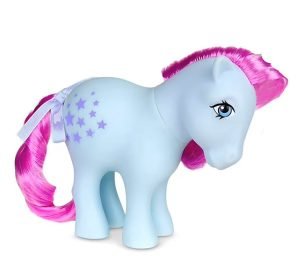
Today, the annual cost of keeping a horse runs between $3,700 and $15,000, depending on the breed and size, which keeps it out of reach for most of us. Throughout history, toy makers have bridged the gap, trotting out many make-believe options: simple stick horses, Victorian-era rocking horses, the suspended rocking horse (also named the Wonder Horse, invented by William Balzin in 1939), and Hasbro’s My Little Pony, released in 1982.
That first day of class all those years ago, I chose not to stuff my head with facts, but to clear it instead. As I galloped across fields, I breathed in air that smelled of fresh cut grass and honeysuckle. I dreamed about the future and what part I would play in it.
Marriage and children eventually left me no time to frolic with horses. It’s been decades since I last rode, but every time I see a horse in a random field I remember the adrenaline that coursed through my veins.
America was built on the backs of horses—strong, noble, and loyal, they have long been mankind’s silent partners.