
As a writer and editor who reads manuscripts daily, I cringe at some of the advice I hear and then see put into practice. At Iowa Writers’ Workshop, when my first set of pages came back, the margins filled with notes, I begged the instructor, Chris Offutt, to tell me where I could lay my hands on the rule book. Once I had the rules, I promised to follow them. Then he explained one of the (many) paradoxes of writing. “There is no rule book,” he said. “But you have to know the rules before you can break them.”
The trick is sorting out what rules are the holy grail versus which are merely masquerading as gospel.
For instance, last week, I heard a writer say, with great conviction, “Attributions always follow dialogue.”
As in: “Darling, pass the sugar,” said Natasha.
This is NOT a rule. It may be better, or even necessary to identify the speaker first, especially if you have a boisterous crowd around the table with Boris begging for blini and Ivan bellowing for borscht.
“More blini,” said Boris.
“Nyet. Bring on the borscht,” said Ivan.
Natasha said, “Darling, pass the sugar.”
If however, our friend Natasha is a drama queen or a seductress (or both!), you might want to emphasize her first word of dialogue by inserting a dramatic pause:
“These blini are to die for,” said Boris.
“Darling,” said Natasha, “pass the sugar.”
And I would be remiss if I did not mention the fact that sometimes, when you’ve established the rhythm of conversation, rather like a tennis match between two people, no attributes at all may be necessary:
“Help yourself to some blini, Boris,” said Natasha, handing him the platter.
Boris smacked his lips and said, “With pleasure.”
“But not too many,” she warned, “or you’ll get fat.”
“Who is fat? Not I. You, my pirozhki, are too skinny.”
“Darling, pass the sugar.”
And one more thing about attributes, while we’re on the subject, limit them to said and asked. No cackled, crowed, or cawed, please.
And here are a couple rules you should follow.
Organize your queries. We get it. Querying can be a fulltime, soul-sucking job. There are tools that make it easier to keep track of who you queried and when. This way you won’t do as one writer has unfortunately done with us: pitch the same project multiple times. (Thrice, to date.)
Would Stephen King pitch Hallmark? Familiarize yourself with what the object of your affection—be it agent, editor, or publisher—loves. Otherwise, you’re wasting everyone’s time, including yours. Read something they’ve represented, published, or edited. Understand what they’re looking for before you send your work. Even better, reference their work in your cover letter.
And just one more, tiny thing, one I almost cannot believe must be said. NEVER start a book with the phrase: “It was a dark and stormy night.” (Yes, we received a query that began with this line, and it was NOT a satire.)
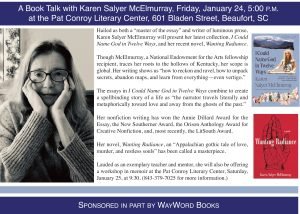
That’s it for the free advice, here’s the details on the free event:
The Bargain:
Karen Salyer McElmurray’s workshop is, quite frankly, a steal at only $60.
Here’s what she’ll be talking about Saturday morning, January 25th:
Endings and Beginnings
Graham Greene once said, “a story has no beginning or end: arbitrarily one chooses that moment of experience from which to look back or from which to look ahead.” This arbitrariness—catching hold of an idea or a dream or a moment of insight—is certainly part of the sheer magic of writing. Deciding how to start a story and how to end it involves careful translation of our original moments of insight. Beginnings and endings become careful revision once we capture the arbitrary experience we begin with. This workshop will look at some examples of openings and endings from essays and longer works of memoir. We will discuss, and we will begin work on some openings of our own.
Participation is limited to 12 people. ($60.00/person ) Advance registration required at: http://endingsandbeginningsworkshop.eventbrite.com