
As an optimist, I always look for the upside. For instance, our recent, less-than-optimal collaboration with a web design firm, I chalked up to a mismatch of needs vs. wants. They needed us to fall into neat, little templated boxes, while we wanted something out of the box.
One good thing came from this debacle: WayWord Books is no longer taking submissions. Let me say that again: We are not open for submissions. There is, in fact, no “Submit” button on our website.
Why, you ask. Because:
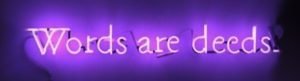
This experience led to the realization that what we say translates ultimately results in actions—good and bad. Buying into the notion that words can be that powerful, got us to wondering what the words we choose to say or write really meant, which led to exploring their etymology.
We did a deep dive into the word submission and discovered the earliest known use of the noun submitten dates to the Middle English period (1150—1500) and can be traced to the Latin submittere (to yield, lower, or put under). Around 1200, submitten was used to define “the practice or virtue of yielding to a higher power or authority.” By the late 14th century, the word meant “to place (oneself) under the control of another” or “dutiful compliance with a command.”
Over time, submission became equated with obedience and patience, enduring and suffering. We asked etymologist Ben Zimmer at the Wall Street Journal to shed some light on when the terms submit and submission became common parlance in the publishing world, but no word from him yet. (If you happen to know, please enlighten us!)
What we have learned is asking a writer to “submit” flies in the face of our mission. We are here to lift up writers. While their patience is certainly appreciated, we never want authors to feel that they are under our control, beneath us, or worse: suffering. Obedience is not necessarily the top quality we look for in a writer, either, although following our guidelines does make our job a tiny bit easier.
Make no mistake, we are still open to receiving stellar manuscripts! But now, instead of submitting, yielding, or otherwise lowering themselves, writers can simply query, from the Latin quaere, i.e., inquire!