
 Forthcoming 2025, Spectacular Failures takes readers deep into the heart of Africa with first-hand accounts of the early Europeans’ observations and interpretations about a continent that was, to them, a whole new world.
S.M. What sparked your interest in those first failed explorations into Africa from 1788–1830?
K.L. I had lived and worked in Africa for many years and, for that reason, decided I wanted to write a book about it. I started—as I often do—by perusing old diaries and journals of Europeans in Africa. After hours of searching various university catalogs, I stumbled across a narrative by a naval commander named James Hingston Tuckey. I had read all the books by explorers like Livingston, Stanley, and Speke but I had never heard of Tuckey. Tuckey, an English captain, led an expedition in 1816 to find the source of the Congo River. I had lived there, in Kinshasa, for two years, so the discovery of Tuckey’s book seemed like an omen. I pursued it further and the result was this book on little-known British explorers of the early 19th century.

S.M. Which explorer’s journey did you find the most compelling?
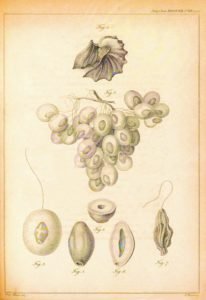
K.L. That’s hard to answer as they were all compelling in their own way. But if I had to choose, I would say it was Tuckey’s. It was the one expedition dedicated to the noble pursuit of knowledge for its own sake. For this reason, it was the only mission staffed with scientists, some of the best—if eccentric—of the day—zoologists, biologists, and draftsmen. They gathered specimens of the strange flora and fauna they encountered, took meticulous notes of their observations, and even rendered beautiful sketches of many of the things they encountered, some of which I included in the book. So much meticulous planning had gone into making the mission a success. Yet it ended so suddenly, so tragically… which, I suppose, is why Tuckey’s journey had been lost to history.
S.M. Which explorer’s failure surprised you the most?
K.M. Without a doubt it was William Gray’s. Gray led an army expedition in search of the mouth of the Niger River, which the British believed flowed into the Congo. Gray, I should point out, volunteered to lead an expedition after its three previous commanders perished from tropical diseases. Gray, too, faced many insurmountable obstacles—hostile (and greedy) natives, illness, interminable delays, and bad weather. Traveling through West Africa, he lost nearly all his animals, yet he pressed on. When the animals died, African soldiers shouldered the heavy loads of equipment, supplies, and gifts for the tribal chiefs. Once they reached the interior, most of his men became ill. The tribal chiefs were happy to receive his gifts but refused to let him pass through their territory. After four long years wandering around West Africa, he finally ran out of money and provisions and returned to England. He was one of the few to survive the ordeal of African exploration.
S.M. How did the explorers defend themselves against theft when they were so outnumbered by Africans and there were no European armies there at the time?
K.L. Well, often they weren’t able to defend themselves and consequently lost much of their stores, even their animals. But the British were, after all, armed with rifles which proved an effective deterrent to would-be thieves.
S.M. Were the Africans afraid of a European invasion at the time of these early explorers since colonization took place fifty years later?
K.L. No, not really. To begin with, these early explorers were not the vanguard of a plan to colonize the region. Not at all. They were there to solve the mystery of two great African rivers—the Congo and the Niger. That said, the British had banned the slave trade in 1807 and had begun to intercept slave ships off the West African coast. Tribal chiefs—and this may come as a surprise to many readers—profited handsomely from the slave trade and did not want the British interfering in their livelihood. They were well aware of the British desire to stamp out the slave trade and for this reason, were suspicious of their motives for being there in the first place. It was one of the reasons the Africans tried to prevent their advance across the interior. To their credit, the British explorers never once resorted to violence to get their way. So, you see their missions lacked the violence and brutality that typically accompanied colonization. These early explorers were not the frontline of colonization, but they were its unwitting harbingers.
S.M. What do you hope readers will take away from your book?
K.L. I would hope that readers learn that European contact with Africa was not always exploitative. In large part, the explorers treated the Africans they encountered with dignity and respect. Spectacular Failures is an opportunity for readers to discover a part of history that is not often taught in school. These expeditions marked the beginning of modern marine biology and advanced the knowledge of other cultures to both the Africans and the Europeans.
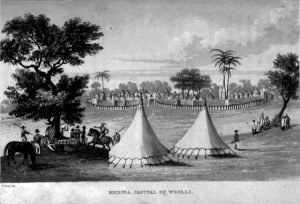
(Images: Medina, Author Ken Lizzio, Spectacular Failures: Early British Expeditions to Africa 1788–1830, Capital of Wooli and drawings by John Cranch)